

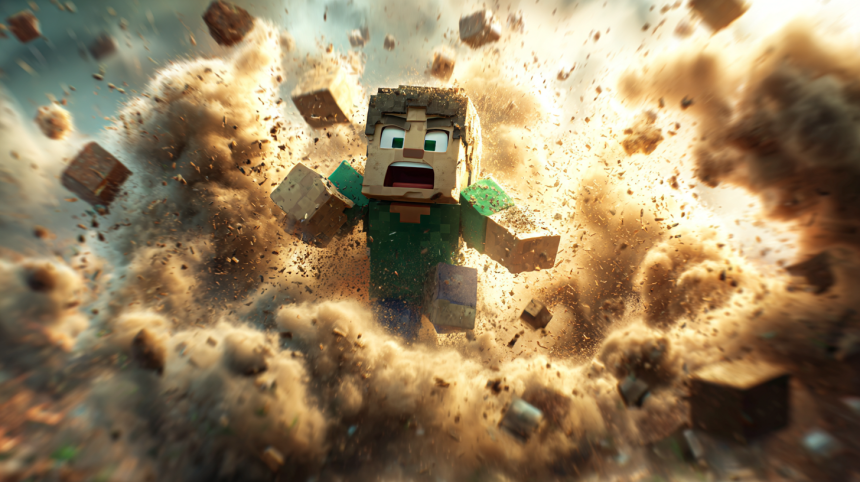
Few sounds in any game carry as much meaning as that quiet little hiss behind your back. A Minecraft Creeper explosion is one of the most famous moments in gaming, and once you understand exactly how it works, you gain real control over it. You can predict it, dodge it, block it, redirect it, turn it off completely, or even put it to work for you.
The fuse has a precise timer. The blast has a measurable radius. Some blocks shrug it off and others vanish instantly. None of it is random, which means all of it can be planned around.
This guide covers the whole picture, from the half-second decisions in combat to the gamerule that keeps your builds safe forever. It also covers why, according to Zolth, you might actually want a few of these green troublemakers sneaking up on you at night.
By the end of this, that hiss becomes a warning you know exactly how to answer.
What Actually Happens During a Minecraft Creeper Explosion
A Creeper explosion is not a sudden event. It is a short sequence, and every step gives you a chance to react. Knowing the sequence is the single biggest skill upgrade you can make against these mobs.
First, the Creeper has to notice you. Creepers detect players from about 16 blocks away and walk straight toward them. They move quietly, with no groaning or rattling like zombies and skeletons, which is exactly why they are so good at sneaking up on people.
Second, the Creeper has to get close. Once it is within roughly 3 blocks of you and can see you, it starts its fuse. You hear the hiss, the Creeper begins to swell, and its texture starts flashing white.
Third, the countdown runs. The fuse lasts 1.5 seconds, which is 30 game ticks. That sounds short, and it is, but it is long enough to sprint several blocks if you move the instant you hear the hiss.
Here is the part many players never learn: the fuse can be cancelled. If you get more than about 7 blocks away, or break line of sight, the Creeper stops swelling and calms down. It will follow you again and restart the whole process, but the explosion does not happen. Running is not panic. Running is a legitimate counterplay.

How Much Damage a Creeper Explosion Does, and How Far It Reaches
A regular Creeper has an explosion power of 3. For comparison, TNT has a power of 4, and a Charged Creeper has a power of 6. That power number controls both how many blocks get destroyed and how far the damage reaches.
For players and mobs, a normal Creeper blast can hurt anything within about 6 blocks of the center. Damage drops off sharply with distance. At point-blank range, an unarmored player on Normal difficulty can take enough damage to be killed from full health. A few blocks back, the same blast might only take a handful of hearts.
Difficulty changes the numbers a lot. On Easy, explosion damage to players is reduced. On Hard, it is increased by half again. On Peaceful, Creepers do not spawn at all, which solves the problem in the most direct way possible.
Armor is the other big factor. Regular armor points reduce explosion damage, but the real specialist is the Blast Protection enchantment. It cuts explosion damage and also reduces the knockback that can launch you off a cliff or into lava. Players who spend a lot of time around Creepers, or near TNT, often keep one Blast Protection piece in their kit.
Shields are the cleanest answer of all. If you are holding a shield up and facing the explosion, it blocks the damage completely. The shield takes durability damage, but you walk away untouched. It is one of the most satisfying moves in the game once you get the timing right.
Which Blocks Survive a Creeper Explosion (and Which Do Not)
Every block in the game has a blast resistance value. The higher the number, the harder it is for an explosion to destroy. A Creeper’s blast only chews through blocks when the explosion’s strength beats that resistance.
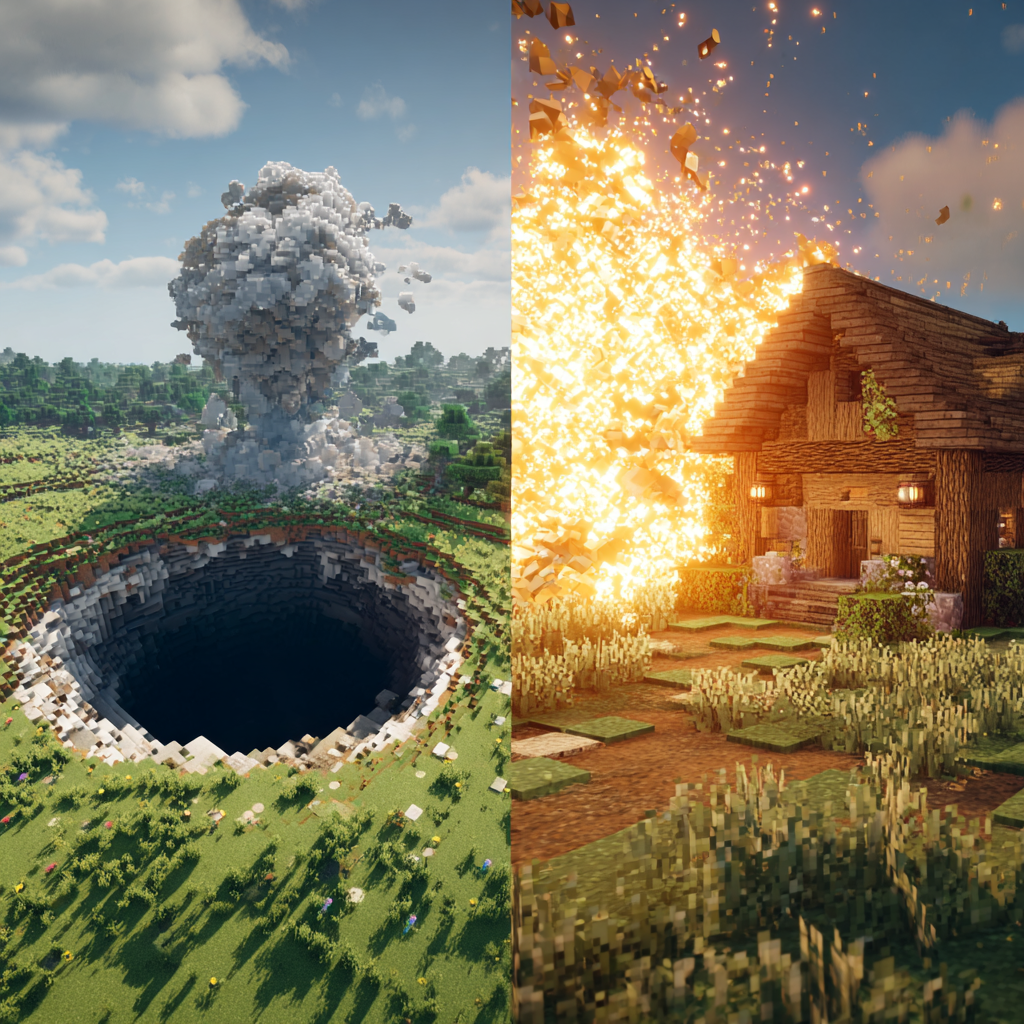
Soft blocks disappear easily. Dirt, grass blocks, sand, gravel, glass, wool, and leaves all break with almost no effort. This is why the classic Creeper crater appears in grassy fields and why a dirt starter house is so vulnerable.
Stone-type blocks are tougher. Stone, cobblestone, stone bricks, and deepslate hold up well against the outer part of the blast. However, a Creeper exploding right against a stone wall can still punch a small hole through it. Stone is resistant, not immune, which catches a lot of players off guard when they find damage in their “safe” bunker.
Then there are the truly blast-proof blocks. Obsidian, crying obsidian, ancient debris, netherite blocks, anvils, enchanting tables, ender chests, respawn anchors, and reinforced deepslate will not break from a Creeper at all. Bedrock, of course, is indestructible to everything.
Water is the secret weapon here. If a Creeper explodes while it is in water, the blast damages entities normally but destroys no blocks. Lava works the same way, though it comes with obvious risks. This is why a shallow moat or a water feature near your walls can quietly prevent a lot of repair work.
Charged Creepers: The Explosion’s Bigger, Louder Sibling
When lightning strikes within a few blocks of a Creeper, it becomes a Charged Creeper. You can spot one by the glowing blue aura that swirls around its body. It looks cool. It is also terrifying.
A Charged Creeper has double the explosion power of a normal one. That means twice the reach for damage and a much larger crater. Up close, it can kill a player in decent armor. In a build, it can leave a hole that takes an evening to repair.
There is a big upside, though. When a Charged Creeper’s explosion kills a zombie, skeleton, wither skeleton, piglin, or another Creeper, that mob drops its head. This is the main way to collect mob heads in survival, and it is the only way to get a Creeper head. In Java Edition, only one head drops per explosion, so you cannot farm a whole stack with one blast.
Players who want Charged Creepers on purpose usually use a trident enchanted with Channeling. During a thunderstorm, throwing a Channeling trident at a Creeper summons lightning and charges it instantly. Luring it near other mobs afterward is where the real challenge starts.

How to Turn Off Creeper Explosions with the mobGriefing Gamerule
If you want Creepers to stay in your world but stop wrecking your builds, one command does the job. It works in both Java and Bedrock Edition, as long as cheats are enabled.
Open chat and type:
/gamerule mobGriefing false
In Bedrock Edition, the command is not case-sensitive, so /gamerule mobgriefing false works too.
With this turned off, Creepers still spawn, still chase you, and still explode. The blast still damages players and mobs. It simply stops breaking blocks. Your builds come through without a scratch.
Before you flip this switch, know that mobGriefing affects much more than Creepers. It also stops Endermen from picking up blocks, Ghast fireballs from breaking terrain, zombies from breaking doors, and the Wither from destroying blocks. It prevents villagers from harvesting and planting crops, which will break automatic villager farms. It stops sheep from eating grass, which means their wool will not regrow. In Java Edition, it also stops many mobs from picking up items, including piglins picking up gold, which disables bartering.
To turn griefing back on at any time, type /gamerule mobGriefing true. Nothing is permanent, so it is safe to experiment.
How to Fight a Creeper Without Letting It Explode
Creepers only have 20 health, the same as a player. They go down quickly if you know the rhythm. The goal is to deal damage while never standing inside that 3-block trigger zone for long.
Bows and crossbows are the safest option. Shoot a Creeper from range and it never gets a chance to hiss. Two or three good arrows usually finish it. This is the go-to method for anyone who values their armor and their base.
For melee, use sprint-hitting. Sprint toward the Creeper and hit it while running. A sprint hit adds knockback, pushing the Creeper away from you. Then step back, wait for it to approach, and repeat. In Java Edition, this rhythm often keeps the Creeper from ever finishing its fuse. A sword with the Knockback enchantment makes this even easier.
If a Creeper does start hissing right next to you, you have three good choices. Raise your shield and face it. Sprint away to get more than 7 blocks of distance. Or step behind a solid block so the blast cannot reach you directly. Standing still and swinging wildly is the choice that ends with respawning.
There is also a special drop. If a skeleton, stray, or bogged shoots and kills a Creeper, the Creeper drops a music disc. Collecting all of them is a long-running goal for many players, and it all starts with getting a Creeper in the way of a skeleton’s arrow.
How to Creeper-Proof Your Base
The best Creeper explosion is the one that never happens near your house. A few simple habits make your base almost Creeper-free.
Lighting comes first. In Java Edition since version 1.18, hostile mobs like Creepers only spawn where the block light level is 0. Torches, lanterns, glowstone, and other light sources stop spawns completely in the area they light. Bedrock Edition also requires a block light level of 0 for spawning, with a limit on sky light too. In both editions, lighting up the ground around your base keeps new Creepers from appearing right outside your door.
Lighting does not stop Creepers that spawn further away and walk over, though. That is where walls come in. A wall two blocks high stops Creepers from walking into your space. Fences and walls count as taller than a normal block, so a single row of fence works as a barrier too.
Cats are the most charming defense in the game. Creepers are afraid of cats and ocelots and will actively flee from them when they get close. A few tamed cats sitting around your entrance or your garden turn into a living alarm system. Tame them with raw cod or raw salmon, tell them to sit, and let them do their quiet work.
Finally, keep nearby caves lit or sealed. Creepers spawn happily in dark caves directly under your base, especially in the deep areas below. If you have ever found a Creeper inside your mine tunnel, it probably came from an unlit cave pocket nearby.
Mushroom Fields biomes are a special case worth knowing. Hostile mobs, including Creepers, do not spawn there naturally at all. The same goes for the Deep Dark. Building in a Mushroom Fields island is one of the most peaceful survival setups available.

Why Night Adventures Are More Fun with the Sound Turned Up
All the defenses above are about protecting your builds. But out in the wild, Creepers play a completely different role. They are the surprise element that keeps nighttime exploration exciting.
Zolth loves this part of the game. When she is out adventuring at night, she can be totally focused on where she is going or what she is working on, and meanwhile a Creeper is quietly sneaking up behind her. Then suddenly, with no warning at all, the explosion goes off.
Her favorite way to play these moments is with the speakers turned up fairly loud. Everything seems calm, attention is locked on the task in front of you, and then that blast comes roaring through the speakers. It genuinely makes you jump. And more often than not, it ends with laughing about it afterward.
That unpredictability is a huge part of what makes nighttime Minecraft feel alive. Zolth is honest about the difference, too: when a Creeper blows up something she spent real time building, it is not nearly as funny. Out exploring, though, that little bit of danger is exactly what she enjoys. You never quite know when one of those green troublemakers is creeping around behind you.
Turning the volume up has a practical side as well. The hiss is your only warning, and you can only react to what you can hear. Good audio gives you that full 1.5 seconds. If you play with sound low or muted, go to the Accessibility settings and turn on subtitles. The game will display a “Creeper hisses” message on screen so you never miss the warning.
Questions Players Ask Me About the Minecraft Creeper Explosion
How far away can a Creeper explosion hurt you?
A normal Creeper can damage players and mobs up to about 6 blocks from the center of the blast. Damage falls off quickly as you move away, so the last few blocks of that range only do minor damage. A Charged Creeper roughly doubles that reach, so give glowing blue Creepers far more room. Walls and solid blocks between you and the blast reduce the damage you take, and a raised shield facing the explosion blocks it completely. On Peaceful difficulty, Creepers do not spawn at all.
Can Creepers blow up stone and obsidian?
Creepers can break stone, but only close to the center of the blast. Stone, cobblestone, stone bricks, and deepslate all have strong blast resistance, so they usually survive the outer edges of the explosion. A Creeper detonating right against a stone wall can still punch a small hole through it. Obsidian is a completely different story. It, along with crying obsidian, ancient debris, netherite blocks, and reinforced deepslate, cannot be destroyed by a Creeper at all, which makes these blocks perfect for protecting anything truly valuable.
How do you stop Creepers from destroying blocks?
The fastest way is the command /gamerule mobGriefing false, which works in both Java and Bedrock with cheats enabled. Creepers will still explode and hurt players, but they will not break blocks. Remember that this gamerule also stops villagers from farming, sheep from regrowing wool, and piglins from bartering in Java. If you want to keep those features, protect your base with bright lighting, two-block-high walls, a water moat, and a few tamed cats instead. Explosions in water never destroy blocks.
Why do Creepers not drop anything sometimes?
A Creeper that blows itself up drops nothing. The explosion destroys the Creeper, and the game treats it as the mob removing itself instead of being killed. To get gunpowder, you need to defeat the Creeper before its fuse finishes, usually with arrows or careful sprint-hits. Killed properly, it drops 0 to 2 gunpowder, and more with Looting. If a skeleton, stray, or bogged kills it with an arrow, you also get a music disc. A Charged Creeper’s blast can make other mobs drop their heads.
Are Creepers afraid of cats in both Java and Bedrock?
Yes, Creepers avoid cats and ocelots in both editions. When a Creeper gets close to one, it turns and runs the other way instead of chasing you. This makes cats one of the best natural base defenses in the game. Tame a stray cat with raw cod or raw salmon, then tell it to sit near your door or in your garden. Ocelots work too, but they are harder to keep in place because they cannot be tamed. A few sitting cats around a base keep Creepers away quietly and reliably.
What happens if a Creeper explodes in water?
If a Creeper is standing in water when it explodes, the blast does not destroy any blocks. It still damages nearby players and mobs, so you are not completely safe, but your walls, floors, and builds survive untouched. This makes water one of the best tools for protecting a build without changing any game settings. A shallow moat around your base, or water features along your walls, stops a lot of block damage. Lava does the same thing, though it comes with plenty of other dangers.
Take Control of Every Minecraft Creeper Explosion
You now know the hiss, the 1.5-second fuse, the 7-block escape, the 6-block damage zone, and the blocks that simply refuse to break. That is everything you need to handle a Minecraft Creeper explosion on your own terms.
You can shut off block damage with a single command. You can build walls, light the ground, and let a few cats stand guard. You can drop Creepers with arrows, block them with a shield, or sprint away the moment the fuse starts. And when you are out exploring in the dark, you can turn the speakers up and let that surprise blast do what it does best: make you jump, and then make you laugh.
Thanks for reading, and enjoy your next night adventure. The Creepers are out there. Now you are ready for every single one of them.