
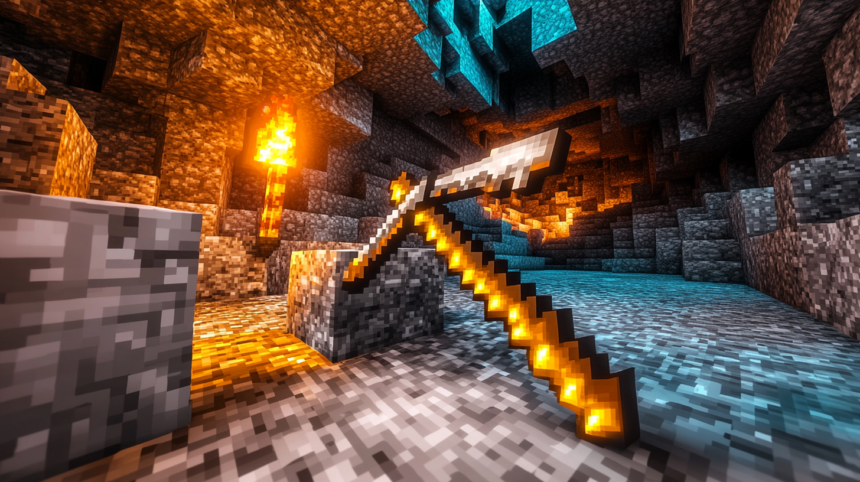
Stone is the block you have already mined ten thousand of and will mine ten thousand more. It makes up the vast majority of the solid terrain between Y-level 0 and Y-level 320, which means every time you dig down, branch mine, or carve out a base, you are punching through stone. Break it with a pickaxe and it drops cobblestone. Want the actual stone block? Bring Silk Touch. Want smooth stone? Smelt the cobblestone. Minecraft loves making you work for the clean version of things.
Stone is one of the oldest blocks in the game — it has existed since the very first version of Minecraft, back when the entire world was basically just stone, grass, and existential dread. It is the backbone of the Overworld’s underground, the primary ingredient in half the recipes you will ever use, and the reason your inventory fills up with cobblestone every time you go mining for anything else.
Despite being the most common solid block underground, stone has genuine utility beyond just being in the way. It is a crafting ingredient, a smelting ingredient, a stonecutting ingredient, and a perfectly respectable building material if you bother to collect it properly. It is also the block that generates when water meets flowing lava — a mechanic that makes cobblestone generators and stone generators possible, which is the entire foundation of skyblock economies.
Overview / Quick Stats
| Attribute | Details |
|---|---|
| Name | Stone |
| Namespaced Block ID | Java: minecraft:stoneBedrock: minecraft:stone |
| Category | Natural |
| Renewable | Yes |
| Stackable | Yes (64) |
| Tool | Pickaxe (any tier; required to drop) |
| Hardness | 1.5 |
| Blast Resistance | 6.0 |
| Luminous | No |
| Transparent | No |
| Flammable | No |
| Gravity-Affected | No |
| First Added | Java Edition Classic 0.0.14a (May 2009) |
| Last Major Change | 1.18 (Caves & Cliffs Part II) — world generation overhaul changed stone distribution |
Appearance
Stone has a flat, grey texture with a slightly mottled pattern — little speckles and cracks that give it a bit of visual variation without being distracting. It is one of the most neutral-looking blocks in the game, which is exactly why builders love it for foundations, walls, and anywhere you need something that does not draw attention to itself.
The texture is identical across Java and Bedrock editions. Stone looks the same from every side — there is no top, bottom, or side texture variation. What you see is what you get from all six faces.
When you smelt cobblestone to get stone, the resulting block is visually identical to the naturally generated stone you find underground. There is no way to tell them apart by looking at them. This is one of the rare cases where Minecraft does not punish you for taking the long way around.
Obtaining
Breaking
Stone requires any pickaxe to mine. If you break it without a pickaxe — with your hand, a sword, a shovel, whatever creative tool choice you made — it drops nothing. Just gone. Time wasted. Lesson learned.
When mined with a pickaxe (without Silk Touch), stone drops cobblestone. To get the actual stone block, you need a pickaxe enchanted with Silk Touch. This is one of the earliest “you need the nicer tool to get the nicer block” gates in the game, and it will not be the last.
| Tool Tier | Breaking Time (seconds) |
|---|---|
| Default (hand) | 7.5 (drops nothing) |
| Wooden Pickaxe | 1.15 |
| Stone Pickaxe | 0.6 |
| Iron Pickaxe | 0.4 |
| Diamond Pickaxe | 0.3 |
| Netherite Pickaxe | 0.25 |
| Golden Pickaxe | 0.2 |
Times are for unenchanted tools as wielded by players with no status effects.
Natural Generation
Stone is the most abundant solid block in the Overworld. It generates as the primary filler block for all terrain between Y-level 0 and Y-level 320 (above the deepslate layer, which takes over below Y 0). In practice, you will find solid stone making up the overwhelming majority of underground terrain in every single biome.
Stone also appears in numerous generated structures. Villages, strongholds, and other structures that generate underground will often be surrounded by or built into stone. The igloo basement generates stone bricks, but the surrounding terrain is typically stone.
Since the Caves & Cliffs update (1.18), stone transitions into deepslate around Y 0, with a gradient zone between Y -8 and Y 0 where both can generate. Above that gradient, it is stone all the way up to wherever the surface starts.
Post-Generation
Stone generates after world creation when flowing water meets the top or side of a lava source block. This is the mechanic behind stone generators — a step up from cobblestone generators if you position the water flow correctly. When water flows on top of a still lava source block, it converts that lava source into stone rather than cobblestone. This distinction matters enormously in skyblock and other limited-resource scenarios.
Silverfish can also infest stone, turning it into an infested stone block. When you break infested stone, a silverfish pops out and the block drops nothing. If you have ever been mining in a stronghold and suddenly had a tiny angry bug crawling at you, now you know why. Infested stone looks identical to regular stone — the only way to tell them apart without breaking them is that infested stone takes slightly longer to mine.
Renewability
Stone is renewable thanks to lava and water interactions. If you have a lava source and flowing water positioned correctly, you can generate infinite stone. This makes stone one of the few natural blocks that you can produce on demand without ever exploring — assuming you have a bucket of lava and a water source, which are also both renewable.
Usage
Crafting Ingredient
Stone is an ingredient in several important recipes. Note that these require the actual stone block, not cobblestone — so you either need Silk Touch or you need to smelt your cobblestone first.
| Result | Ingredients | Recipe Description | Notes |
|---|---|---|---|
| Stone Slab | 3 Stone | 3 stone in a horizontal row → 6 stone slabs | Also obtainable via stonecutter |
| Stone Stairs | 6 Stone | 6 stone in stair pattern → 4 stone stairs | Also obtainable via stonecutter |
| Stone Button | 1 Stone | 1 stone anywhere in grid → 1 stone button | — |
| Stone Pressure Plate | 2 Stone | 2 stone in a horizontal row → 1 stone pressure plate | Only activated by entities, not items |
| Redstone Repeater | 3 Stone + 2 Redstone Torches + 1 Redstone Dust | 3 stone along bottom, 2 torches on left and right, 1 redstone center | — |
| Redstone Comparator | 3 Stone + 3 Redstone Torches + 1 Nether Quartz | 3 stone along bottom, 3 torches in V pattern, 1 quartz at top center | — |
| Stonecutter | 3 Stone + 1 Iron Ingot | 3 stone along bottom, 1 iron ingot center | — |
Smelting Ingredient
| Result | Ingredients | XP |
|---|---|---|
| Smooth Stone | Stone + any fuel | 0.1 XP |
Yes, the smelting chain for smooth stone is: mine stone (get cobblestone) → smelt cobblestone (get stone) → smelt stone (get smooth stone). That is two smelting operations and twice the fuel for a block that looks marginally cleaner. Welcome to Minecraft, where aesthetics cost resources.
Stonecutting
The stonecutter is one of the most underrated blocks in the game, and stone is one of the best reasons to use it. Placing stone in a stonecutter gives you access to several outputs at better material ratios than the crafting table.
| Result | Ingredients | Quantity |
|---|---|---|
| Stone Slab | 1 Stone | 2 |
| Stone Stairs | 1 Stone | 1 |
| Stone Bricks | 1 Stone | 1 |
| Stone Brick Slab | 1 Stone | 2 |
| Stone Brick Stairs | 1 Stone | 1 |
| Stone Brick Wall | 1 Stone | 1 |
| Chiseled Stone Bricks | 1 Stone | 1 |
That 1 stone → 1 stone bricks conversion in the stonecutter is much better than the crafting table’s 4 stone → 4 stone bricks. It is the same ratio mathematically, but the stonecutter also gives you direct access to stone brick stairs, slabs, and walls from a single stone block — skipping the intermediate crafting step. If you are building anything with stone bricks, the stonecutter saves you time and effort.
Building & Construction
Stone is a workhorse building block. Its neutral grey color makes it an excellent foundation material, filler for walls, and base layer for floors. It pairs well with stone bricks, smooth stone, and andesite for builds that need a clean, monochrome palette.
For builders, stone sits in a useful middle ground — it is less rough than cobblestone but less polished than smooth stone. This makes it ideal for transitions between raw and refined sections of a build, like the walls of a mine shaft that gradually become a finished room.
Stone is also fireproof and blast-resistant enough to survive most explosions that are not a Wither or a charged Creeper at point-blank range. A blast resistance of 6.0 will not stop TNT, but it will shrug off ghast fireballs without flinching.
Redstone
Stone is a crafting ingredient for three key redstone components: the redstone repeater, the redstone comparator, and the stone button. The stone pressure plate is also a redstone component, and it has the useful property of only being activated by entities (players, mobs, minecarts) — not by dropped items. This makes stone pressure plates the go-to for doors that open when you walk up but do not trigger when you accidentally throw your sword on the ground.
Other Uses
- Note Blocks: A note block placed on top of stone produces a bass drum sound. This applies to stone and all stone-type blocks.
- Silverfish Infestation: Silverfish can enter stone blocks, turning them into infested stone. This happens when a silverfish is attacked near stone and does not die — it will burrow into adjacent stone blocks. The infested version looks identical but drops a silverfish and nothing else when broken.
Variants
Cobblestone
The drop you get when you mine stone without Silk Touch. Cobblestone has a cracked, rough texture and is one of the most common blocks you will accumulate. It has its own set of recipes (furnace, tools, brewing stand, etc.) and is functionally the “raw” version of stone. Smelt it to get stone back.
Smooth Stone
The result of smelting stone in a furnace. Smooth stone has a cleaner, flatter texture with a subtle border on the top and bottom faces. It is used to craft blast furnaces and smooth stone slabs, and it is a popular building block for modern or clean-looking builds.
Stone Bricks
Crafted from 4 stone in a 2×2 grid (or 1 stone in a stonecutter). Stone bricks have a refined, masonry look and come in several sub-variants: regular, mossy, cracked, and chiseled. They generate naturally in strongholds, igloos, jungle temples, ocean ruins, and ruined portals.
Infested Stone
Looks exactly like regular stone but contains a silverfish. Found naturally in strongholds and mountain biomes (in the windswept hills biome family). Breaks slightly slower than regular stone with a pickaxe and slightly faster with your hand — which is actually a reliable way to identify it if you are paying attention to mining speed.
Deepslate
The deeper cousin of stone that generates below Y 0. Deepslate is darker, tougher (hardness of 3.0 versus stone’s 1.5), and has its own complete set of variants. It replaced stone as the primary underground block in the deep layers starting in 1.17/1.18.
Block States & Data Values
Stone has no block states — it is a simple, solid block with no orientation, waterlogging, or other properties. What you place is what you get.
| Property | Value |
|---|---|
| Java Namespaced ID | minecraft:stone |
| Bedrock Namespaced ID | minecraft:stone |
| Bedrock Numeric ID | 1 |
| Block States | None |
Interactions with Mobs & Entities
- Silverfish: Silverfish can enter stone blocks, converting them into infested stone. When an infested stone block is broken, the silverfish emerges and attacks the player. If the silverfish is damaged but not killed, it can call nearby silverfish from other infested blocks, causing a chain reaction of angry bugs.
- Mob Spawning: Stone is a valid spawning surface for hostile mobs. In dark caves, mobs will happily spawn on stone — which is most of the underground, which is why cave exploration without torches is a death wish.
- Endermen: Endermen cannot pick up stone. Your underground base is safe from their redecorating tendencies.
- Wither: The Wither’s projectiles can destroy stone. The blue skulls (from the Wither at half health) have a blast power high enough to break stone easily.
Commands
/setblock ~ ~ ~ minecraft:stone/fill ~-5 ~ ~-5 ~5 ~3 ~5 minecraft:stone/give @s minecraft:stone 64Bedrock Edition uses the same syntax for /setblock and /fill. For /give, Bedrock uses:
/give @s stone 64Tags & Gamerules
#minecraft:mineable/pickaxe— stone is mineable with a pickaxe#minecraft:base_stone_overworld— identifies stone as a primary terrain block in the Overworld; used by world generation and ore placement#minecraft:stone_ore_replaceables— ores can replace this block during world generation#minecraft:dripstone_replaceable_blocks— dripstone features can replace this block during generation#minecraft:moss_replaceable— moss can spread over and replace this block#minecraft:lush_ground_replaceable— lush cave features can replace this block
Edition Differences
- Block ID History (Bedrock): In older Bedrock editions, stone shared its numeric ID (1) with granite, diorite, andesite, and their polished variants via data values. These have since been split into separate block IDs in current Bedrock versions.
- Stone Generation Mechanics: The lava-to-stone conversion (water flowing over a lava source) works identically in both editions. Stone generators function the same way in Java and Bedrock.
- Infested Stone: Infested stone behavior is consistent across both editions — same appearance, same silverfish spawning on break, same mining speed differences.
Sounds & Audio
- Breaking:
block.stone.break - Placing:
block.stone.place - Stepping:
block.stone.step - Falling:
block.stone.fall - Hitting (while mining):
block.stone.hit
Sound events are identical between Java and Bedrock for stone. The stone sound category also applies to many other stone-type blocks (cobblestone, stone bricks, andesite, etc.).
History & Major Changes
- Classic 0.0.14a (2009): Stone added to the game. One of the original blocks alongside grass, dirt, cobblestone, and wood planks.
- Indev (2010): Stone now drops cobblestone when mined instead of itself. This was one of the earliest resource-processing changes in Minecraft.
- Java 1.0 (2011): Silverfish and infested stone added with the stronghold structure.
- Java 1.3.1 (2012): Silk Touch enchantment allows stone to drop itself when mined.
- Java 1.8 (2014): Granite, diorite, and andesite added. These generate in the same layers as stone, slightly reducing the total amount of stone per chunk.
- Java 1.14 (2019): Stonecutter added, giving stone direct conversion paths to stone bricks, slabs, stairs, and walls.
- Java 1.17 (2021): Deepslate added as the deep-layer equivalent of stone.
- Java 1.18 (2021): World generation overhaul. Stone now generates between Y 0 and Y 320 (previously Y 0 to Y 256). Below Y 0, deepslate replaces stone as the primary terrain block.
Trivia
- Stone’s numeric ID in Bedrock Edition is 1 — it was the very first block added to the game’s registry, beating even grass and dirt.
- The gold pickaxe mines stone faster than the diamond pickaxe (0.2 seconds vs. 0.3 seconds), which is a fun fact that perfectly summarizes why gold tools are fast but useless — they break before you finish the second row of your mine.
- In the real world, “stone” is not a specific material — it is a general term for any naturally occurring solid aggregate of minerals. Minecraft’s stone most closely resembles a generic grey limestone or a fine-grained sandstone in appearance.
- Stone was originally cobblestone’s texture. The textures were swapped during early development, and cobblestone got the rough version while stone got the smoother one.
- A single chunk of Overworld terrain (16x16x384 blocks) contains tens of thousands of stone blocks, making it by far the most common solid block in the game by total volume.