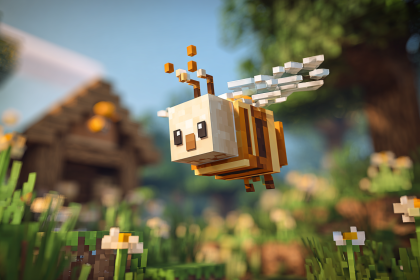

The ghastling is proof that even the most terrifying mobs in Minecraft can have a cute phase. This pint-sized baby version of the happy ghast floats around the Overworld like a lost balloon at a birthday party, smiling at everything and posing a threat to absolutely nothing. It is the juvenile form of the happy ghast, added in the Chase the Skies game drop (Java 1.21.6 / Bedrock 1.21.90), and it represents the middle stage in one of the most unique mob lifecycles Minecraft has ever introduced.
You do not find ghastlings wandering around in caves or spawning at night like most mobs. Instead, you grow one. The process starts with a dried ghast block — a sad, dehydrated little skull you rescue from the Nether — and ends with a floating, snowball-loving baby that will eventually grow into a rideable flying mount. It is essentially Minecraft’s version of a Tamagotchi, except this one can fly and does not beep at you at 2 AM.
Ghastlings cannot be harnessed or ridden. They are purely the growing stage between a dried ghast block and a fully mature happy ghast. But they are far from useless — understanding how they work, what they need, and how to speed up their growth is the key to unlocking one of the most exciting mobs Minecraft has added in years.
Overview / Quick Stats
| Attribute | Details |
|---|---|
| Name | Ghastling |
| Namespaced Entity ID | minecraft:happy_ghast (baby variant) |
| Alignment | Passive |
| Dimensions / Hitbox | Slightly larger than a single block. Fits through a 2-block-wide opening. Smaller than the adult happy ghast (4x4x4). |
| Health | 20 (10 hearts). Slowly regenerates health. Regeneration speeds up during rain, snow, or when flying near cloud level (Y 187–196). |
| Armor | None |
| Base Damage | None. Ghastlings cannot attack. |
| Movement Speed | Slow floating drift. Cannot be ridden or controlled. |
| Knockback Resistance | None |
| Follow / Detection Range | Follows the nearest player or passive/neutral mob within 16 blocks. Idles within 32 blocks of its home position if no target is nearby. |
| Experience Drop | 1–3 XP orbs when killed by a player (Bedrock). Minimal XP in Java. |
| Spawn Location | Overworld only. Spawns from a fully waterlogged dried ghast block after approximately 20 minutes. |
| First Added | Java: 25w15a (Snapshot) Bedrock: 1.21.80.25 (Preview) |
| Last Major Change | Java: 1.21.6 (Chase the Skies, full release) Bedrock: 1.21.90 (Chase the Skies, full release) |
Appearance
Ghastlings look like someone put a regular ghast in the dryer and it came out at about a quarter of the size. They share the same white, blocky body shape as their Nether-dwelling cousin, but with a few key differences that make them unmistakably friendlier.
The most obvious difference is the face. Where a regular ghast wears a permanent frown of existential dread, the ghastling sports a happy smile. It has the same square body and stubby tentacles, but the tentacles are noticeably shorter relative to its body size compared to an adult ghast or even a full-grown happy ghast.
Underneath the skin, ghastlings have visible pink gills — a nice visual touch that hints at why these creatures need water to come to life in the first place. They are slightly larger than a standard block, making them small enough to fit through a 2-block-wide gap but still big enough that you will not accidentally lose one behind your crafting table.
Mojang has described ghastlings as “very curious” mobs that “fly around like a balloon.” That is a remarkably accurate description. Watching one float around your base is equal parts adorable and slightly unnerving, like a happy surveillance camera with tentacles.
Behavior & AI
- Imprinting: When a ghastling spawns from a waterlogged dried ghast block, it imprints on the nearest player or passive/neutral mob. It will then follow that entity around, staying loosely tethered to them like a floating pet.
- Roaming Range: If no player or suitable mob is within 16 blocks, the ghastling idles within a 32-block radius of its home position. The home position is wherever it spawned or was last interacted with.
- Home Reset: If the ghastling moves more than 16 blocks beyond the border of its home area, the home position resets to the new location.
- Following Happy Ghasts: As of 25w18a (Java) and beta 1.21.90.21 (Bedrock), ghastlings also follow nearby happy ghasts, which makes sense — even baby blobs need a parental figure.
- Passive Nature: Ghastlings cannot attack anything. They have zero offensive capability. They are the pacifists of the Minecraft mob roster, floating around and vibing without a care in the world.
- Water Immunity: Ghastlings do not take drowning damage in water. Given that they literally come from a block soaking in water, this makes sense. They are the only ghast variant that has an actual relationship with water that does not involve screaming.
- Fire and Lava: Unlike the regular Nether ghast, ghastlings are not immune to fire or lava. Keep them away from your fireplace.
- Despawning: Ghastlings do not despawn naturally. Once you have one, it sticks around until it grows up or something kills it.
- Leashing: Ghastlings can be put on a lead to keep them from floating off into the sunset.
Abilities, Attacks & Status Effects
- Attacks: None. Ghastlings have no attacks whatsoever. They cannot shoot fireballs, they cannot melee, and they cannot give you a disapproving look. They are purely passive.
- Health Regeneration: Ghastlings slowly regenerate health over time at approximately half a heart every 30 seconds. This rate increases significantly during rain, snow, or when the ghastling is flying at cloud level (Y 187–196), boosting to roughly half a heart per second. Getting rained on is basically a spa day for these mobs.
- Immunities: Immune to drowning damage. Not immune to fire, lava, fall damage (though they float, so this rarely matters), or any other damage source.
- Status Effects: Can be affected by all standard status effects. Not classified as undead, so Instant Damage hurts them and Instant Health heals them — same as the regular ghast.
Food, Taming, Breeding & Growth
- Food: Snowballs. Feed a ghastling snowballs to accelerate its growth into a happy ghast. Each snowball advances the growth timer, similar to how feeding wheat to a baby cow speeds up its maturation.
- Taming: Ghastlings are not “tamed” in the traditional Minecraft sense like wolves or cats. There is no taming mechanic with hearts appearing overhead. Instead, they naturally imprint on and follow the nearest player after spawning. The relationship is closer to “this creature likes you because you gave it water” than “this creature is now your loyal servant.”
- Breeding: Ghastlings cannot breed. They are a juvenile form and can only be obtained from waterlogging a dried ghast block or via commands/spawn eggs.
- Growth Time: Approximately 20 real-world minutes to grow from a ghastling into a full happy ghast, matching the same 20-minute timer it takes for the dried ghast to become a ghastling in the first place. Feeding snowballs speeds this up considerably.
- Cannot Be Ridden: You cannot put a harness on a ghastling or ride it. It is too small and too young. You need to wait for it to mature into a happy ghast first. Patience is not optional here.
- Leash: Ghastlings can be attached to a lead. When leashed, their roaming distance shrinks significantly.
Spawning
| Spawn Condition | Details |
|---|---|
| Location | Overworld only. Spawns from a waterlogged dried ghast block. |
| Biomes | Any Overworld biome where water can exist. The dried ghast block itself is found in the Nether (Soul Sand Valley near Nether Fossils), but the ghastling spawns wherever you place the block in water. |
| Y-Level Range | Any Y-level where a waterlogged dried ghast block can be placed. |
| Light Level | Any. Light level has no effect on ghastling spawning. |
| Required Block | Dried ghast block must be fully submerged/waterlogged in water for approximately 20 continuous minutes. |
| Group Size | 1 per dried ghast block. Each block produces exactly one ghastling. |
| Spawn Egg | The happy ghast spawn egg has a 5% chance of spawning a ghastling instead of an adult happy ghast. |
| Edition Differences | Java: Summon with /summon happy_ghast ~ ~ ~ {Age:-999}Bedrock: Summon with /summon happy_ghast ~ ~ ~ ~ ~ minecraft:spawn_baby |
Here is the important thing about spawning ghastlings: the process is not complicated, but it is very easy to mess up. The dried ghast block must remain continuously waterlogged for the full 20 minutes. If you break the block during the waterlogging process, it reverts to its dry state regardless of how far along it was. If you remove it from water, it will slowly revert back through its stages at the same rate it progressed. Twenty minutes of patience, undone in one accidental pickaxe swing.
During the waterlogging process, the dried ghast block goes through three visible stages. Its expression changes from sad to neutral to happy, and it produces green particles as it hydrates. You will know it is working. Once the timer completes, the block transforms into a ghastling and floats away from the water source. The dried ghast block you found in the Nether near fossils, crafted with 8 ghast tears and 1 soul sand, or bartered from piglins is now a living, floating baby mob.
Interactions with Environment & Other Mobs
- Players: Ghastlings follow the nearest player within 16 blocks after spawning. They are attracted to players holding snowballs.
- Happy Ghasts: Ghastlings will follow nearby happy ghasts, creating a cute parent-child floating caravan if you have both in the same area.
- Passive/Neutral Mobs: If no player is nearby, a ghastling may follow non-baby, non-aquatic passive or neutral mobs within 16 blocks. Your cows might suddenly have a floating white companion.
- Hostile Mobs: Ghastlings have no defenses against hostile mobs. They can be damaged and killed by any hostile entity. A skeleton does not care how adorable your baby ghast is.
- Withers: Ghastlings can be hurt by withers. They do not flee from them either, because their AI does not include self-preservation instincts.
- Boats and Minecarts: Ghastlings cannot be placed in boats or minecarts due to their floating nature.
- Leads: Ghastlings can be leashed. When leashed, their roaming distance is reduced, keeping them close to the leash point or the player.
Drops & Loot
| Item | Quantity | Chance | Notes |
|---|---|---|---|
| Nothing | 0 | 100% | Ghastlings drop no items when killed. They are baby mobs with no loot table of their own. |
| Experience | 1–3 | When killed by player | Minimal XP. Killing ghastlings for experience is both inefficient and morally questionable. |
Player Uses & Farming
- Primary Purpose: The ghastling exists solely as the growth stage between a dried ghast block and a happy ghast. Its entire purpose is to eventually become a rideable flying mount. Think of it as the awkward teenager phase of the happy ghast lifecycle.
- Speeding Up Growth: Feed the ghastling snowballs to accelerate its growth. Snowballs are trivially easy to farm from snow biomes or by placing a snow golem in a warm biome and mining the snow trail it leaves. Stock up before you start the process.
- Dried Ghast Acquisition: You can obtain dried ghast blocks three ways — find them naturally near Nether Fossils in Soul Sand Valleys, craft them with 8 ghast tears and 1 soul sand, or barter with piglins for a chance at one.
- Multiple Ghastlings: You can waterlog multiple dried ghast blocks simultaneously to produce multiple ghastlings. There is no limit beyond how many dried ghast blocks you have and how much water you can fill. Building a “ghast nursery” is a real strategy.
- No Farming Value: Ghastlings drop nothing useful. Do not build a farm around them. Their value is entirely in what they become, not what they drop.
- Keeping Them Safe: Since ghastlings have no defense and can be killed by hostile mobs, it is worth enclosing your hydration area in a well-lit, fenced space. Losing a ghastling to a random zombie after waiting 20 minutes for it to hatch is the kind of frustration that makes people close the game for the night.
Commands & NBT
Ghastlings share the happy_ghast entity ID with the adult form. To summon a ghastling specifically, you need to specify the baby variant:
Java Edition:
/summon happy_ghast ~ ~ ~ {Age:-999}The Age tag set to a negative value determines how long until the ghastling matures. -999 gives you a fresh ghastling with a full growth timer.
Bedrock Edition:
/summon happy_ghast ~ ~ ~ ~ ~ minecraft:spawn_babyThis uses the Bedrock spawn event system to trigger the baby variant directly.
Other useful commands:
/summon happy_ghast ~ ~ ~ {Age:0}This spawns an adult happy ghast immediately, skipping the ghastling stage entirely.
Age(Java): Negative values indicate baby status. The ghastling grows up when Age reaches 0. Each tick increments Age by 1. SettingAge:-24000gives roughly 20 minutes of baby time at 20 ticks/second.ForcedAge(Java): Used when feeding snowballs accelerates growth. Tracks the forced growth amount separately from natural aging.
Tags, Gamerules & Datapack Hooks
- Entity Type Tag:
#followable_friendly_mobs— Non-baby entities in this tag are followed by ghastlings. This is how the game determines which mobs ghastlings will trail after. - Entity ID:
minecraft:happy_ghast— There is no separate entity ID for ghastlings. They are baby happy ghasts, differentiated by theAgeNBT tag (Java) or spawn events (Bedrock). - Loot Table:
loot_tables/entities/happy_ghast.json— Shared with the adult form. Can be modified via datapacks to add custom drops. - Gamerule
mobGriefing: Does not affect ghastlings since they cannot interact with or destroy blocks.
Difficulty & Edition Differences
- Difficulty Scaling: Ghastlings are passive and do not deal damage, so difficulty level (Easy/Normal/Hard) has no direct effect on their behavior or stats.
- Java vs. Bedrock — Summon Commands: Java uses
{Age:-999}NBT, while Bedrock uses theminecraft:spawn_babyevent. These are not interchangeable. - Java vs. Bedrock — Spawn Egg: Both editions support the 5% ghastling chance from the happy ghast spawn egg.
- Java vs. Bedrock — Health History: In early Bedrock previews (beta 1.21.80.25), the happy ghast and ghastling had 40 HP (20 hearts). This was reduced to 20 HP (10 hearts) in beta 1.21.80.27 to match Java.
- Java vs. Bedrock — Collision Box: The ghastling collision box was adjusted in Bedrock beta 1.21.90.21 to better match intended behavior.
- Ghastling Spawn Egg: Ghastlings do not have their own spawn egg in Creative Mode. They can only be obtained through dried ghast waterlogging, commands, or the 5% chance from the happy ghast egg.
Sounds & Audio
- Ambient: Ghastlings produce soft, high-pitched ambient sounds — noticeably more cheerful and less soul-crushingly depressing than their Nether counterpart. Sound events use the
entity.happy_ghastnamespace. - Hurt:
entity.happy_ghast.hurt— A squeaky, distressed sound when taking damage. - Death:
entity.happy_ghast.death— You will feel bad hearing this one. - Feeding: Standard snowball impact sounds when you throw snowballs at a ghastling to speed up growth, along with growth-related particle effects.
History & Major Changes
- March 22, 2025 (Minecraft Live): Happy ghasts and ghastlings officially announced alongside the Chase the Skies game drop.
- Java 25w15a: Ghastlings and happy ghasts added to Java snapshots for the first time.
- Java 25w18a: Ghastlings now follow happy ghasts in addition to players and passive mobs.
- Bedrock 1.21.80.25 (Preview): Ghastlings and happy ghasts added behind the “Drop 2 2025” experimental toggle.
- Bedrock 1.21.80.27: Happy ghast and ghastling health reduced from 40 HP to 20 HP to match Java Edition.
- Bedrock 1.21.90.20: All features behind the “Drop 2 2025” toggle made available in normal gameplay.
- Bedrock 1.21.90.21: Ghastlings now follow happy ghasts. Collision box adjusted for ghastlings.
- Java 1.21.6 / Bedrock 1.21.90 (June 17, 2025): Chase the Skies officially released. Ghastlings are now part of the base game in both editions.
- Bedrock 1.21.100.22: Happy ghasts (and by extension the entity type) now drop 1–3 experience when killed by a player.
Notable Bugs & Quirks
- Breaking Mid-Hydration: If you accidentally mine the dried ghast block while it is hydrating, it reverts all the way back to its dry state. There is no partial progress saving. Twenty minutes of progress, gone in a single click. Put your pickaxe away.
- Reverting Out of Water: Removing a dried ghast from water does not instantly reset it. Instead, it slowly reverts through its stages at the same rate it progressed. This means a block that was 15 minutes in will take 15 minutes to fully revert — a weirdly patient mechanic for Minecraft.
- No Spawn Egg: Ghastlings do not have their own dedicated spawn egg in Creative Mode. This is unusual for baby mobs, as most babies can be spawned by using the adult spawn egg on another adult. Since ghastlings cannot breed, the only spawn egg method is the 5% chance from the happy ghast egg.
- ViaBackwards Scale Issues: Players using ViaBackwards to connect newer clients to older servers have reported that ghastling models appear at incorrect sizes, with the visual scale and hitbox mismatched. This is a third-party compatibility issue, not a vanilla bug.
Advancements / Achievements
- Chase the Skies advancements: While there is no specific advancement for spawning a ghastling, the overall happy ghast lifecycle is tied to the Chase the Skies game drop advancement chain. Riding a happy ghast after raising one from a dried ghast qualifies for related progress.
- Community Challenges: During the Chase the Skies launch event (June 20, 2025), Mojang ran community challenges including feeding one million snowballs to ghastlings globally. Completing these challenges rewarded all players with exclusive skins (Java) and Character Creator items (Bedrock).
Spin-offs, Culture & Trivia
- “Chuckle”: A group of happy ghasts or ghastlings is officially called a “chuckle.” This is one of the better collective nouns in gaming.
- Movie and Legends Origins: The concept of a friendly ghast originated in both Minecraft Legends (as a rideable ghast mount) and A Minecraft Movie (where ghasts are shown being mistreated by piglins). The ghastling is the result of both those ideas evolving into the base game.
- Lore Implications: The fact that dried ghasts come from the Nether and become happy when given water in the Overworld suggests that regular Nether ghasts might just be dehydrated and miserable. The game is quietly implying that the most terrifying flying mob in the Nether is really just thirsty. That recontextualizes a lot of near-death experiences.
- Balloon Behavior: Mojang described ghastlings as flying around “like a balloon,” which is exactly what they look like. If you have ever lost a helium balloon at a county fair, you know the energy a ghastling brings to your base.
- Ghastling Has No Spawn Egg: Despite being a major new mob, ghastlings do not have a dedicated spawn egg. They are one of the few mobs in the game where the only vanilla survival method of obtaining one involves a 20-minute real-time wait.
See Also
- Happy Ghast — The adult form of the ghastling and Minecraft’s first rideable flying mount.
- Dried Ghast — The block that starts the entire lifecycle. Found in the Nether near fossils.
- Ghast — The hostile Nether variant. Same species, very different attitude.
- Harness — The item needed to ride a mature happy ghast. Crafted with leather, glass, and wool.
- Snowball — The key item for accelerating ghastling growth.
- Lead — Used to leash ghastlings and happy ghasts to keep them from roaming.